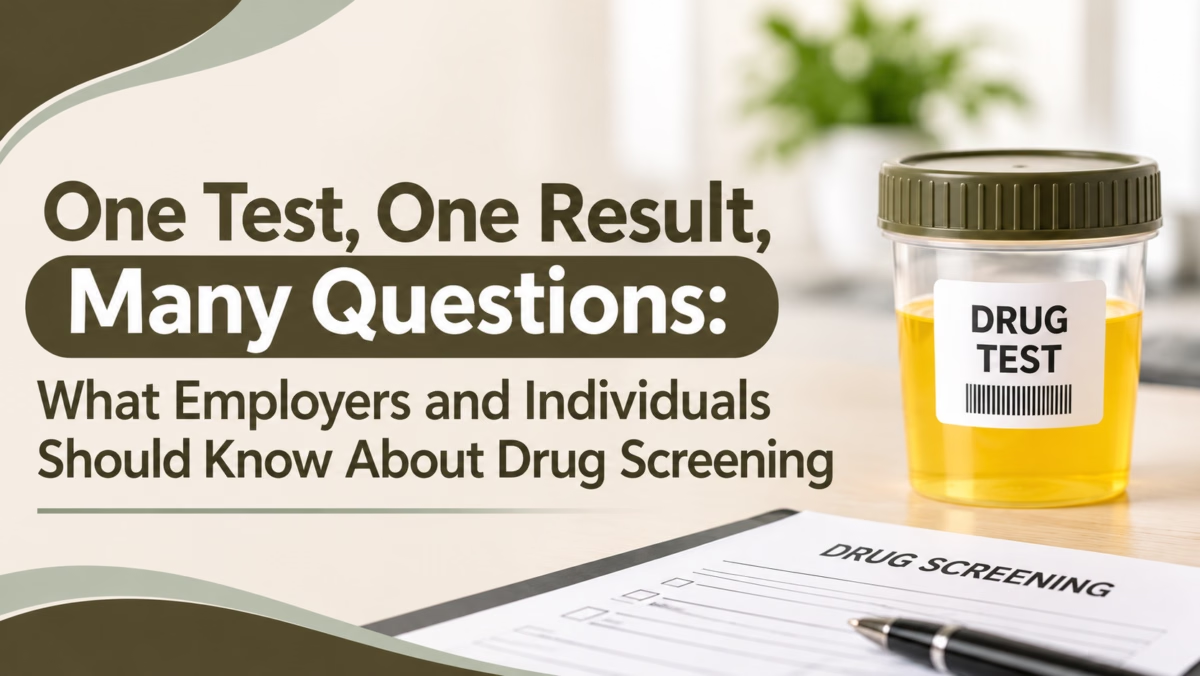
You get the call on a Monday. Go in and take a drug test, they say. You do; you hand over the cup and then nothing. Days go by. What did they actually test for? How far back can it go? And what does a single result really tell you?
Employers have the same issue from the other side of the desk. What test do we order? What does our policy have to say? What do we do if someone comes back positive? No one ever thinks about any of that until they actually have to.
If you’re looking at Drug Testing Austin providers, whether it’s for your company or for yourself, then a bit of background goes a long way. You need to know what the test is actually measuring, how long a substance stays in the system, what the lab does, and what a result can and can’t tell you.
Not all drug tests work the same way
There are four types of samples, and they don’t answer the same question.
Urine is the one you’ve heard of (covers anywhere from a few hours to as much as two weeks depending on the substance). Oral fluid (saliva) is for the very recent past, minutes up to about two days. Hair goes back around 90 days, which sounds pretty good until you realize it can’t tell you when during those 90 days the use actually occurred. Blood will pick up on active substances, but only for a very short time, and as it’s an invasive sample, most places won’t go for it first.
Pick the method based on why you’re testing. A pre-employment screen, a post-accident test, and a return-to-duty test all require different look-back periods. For some employers, there’s no alternative, as federal programs accept only urine and oral fluid, and hair is not permitted for federally mandated testing. The rules should dictate the choice, not the cheapest option.
Detection windows and what they can’t tell you
Why do the windows vary so much? Because bodies break things down at different rates, and most tests aren’t actually looking for the drug at all. They’re looking for the metabolites, the by-products of the drug that your body produces as it processes it. Dose, frequency of use, metabolism, and body composition all affect the window. Marijuana is the most obvious example. A single use will show in urine for about three days. For a regular user, 30 days or more isn’t out of the question.
Now the big one. A positive doesn’t mean impaired. Urine tests pick up non-psychoactive metabolites, which can remain in the body long after the effects wear off. A positive just means that someone used a substance within that window. It tells you nothing about how they were doing at the time of the sample, so you need a qualified person to interpret the result.
Workplace drug screening: what employers should know
Most employers end up with some version of four scenarios. There’s pre-employment testing, which takes place before the actual hire. There’s random testing, where you pull names from a pool with no warning at all (required for DOT-regulated jobs; optional in other cases). There’s post-incident testing, which is carried out following an incident or injury. And then there’s reasonable suspicion testing, which is triggered when a supervisor has actually observed some of the signs.
Whatever program you use, the programs that really work all have three characteristics: a written policy, the same rules for everyone, and good records. Uneven testing is almost always the source of the legal and fairness issues.
The rules also vary depending on who regulates you. Texas has no general law that applies to private employers, though DOT-regulated employers are subject to federal rules, which override any state law (marijuana included). A state medical program won’t override a verified federal result. Federal contractors and certain other industries have additional requirements, so if you’re in any doubt, consult an attorney.
False positives, false negatives, and confirmatory testing
The first screen is typically an immunoassay (uses antibodies to flag the drug); it’s quick and cheap but can cross-react, so one compound can be confused with another. A non-negative screen is therefore only a screening result. Cold medicine can give a false positive,e as can some of the antidepressants, ADHD meds,ds and even poppy seeds. In Texas, legally sold hemp products can contain enough THC to give a true positive.
Any non-negative result goes to confirmatory testing (GC-MS or LC-MS/MS) to identify the substance. Cutoffs are used to minimize false positives. At the federal level, the urine cutoff for the marijuana metabolite is 50ng/mL at screening and 15ng/mL at confirmation. False negatives will also occur, generally where the sample is outside the detection window or below the cutoff.
Positives go to a Medical Review Officer (MRO), a licensed physician, who will have a confidential discussion with you about any legitimate explanation. If you’re on a prescription medication, that’s the time to let them know.
How to prepare for a drug screening appointment
You don’t need much, just a bit of care. Read the instructions first, so you know where you’re going, by when, and what you’re being tested on. Take a valid photo ID and any documentation you’ve been given.
At the collection site, you’ll do the usual: they’ll seal and label your sample and have you sign the custody forms. It can seem a bit fussy, but it’s all to protect your result, and if anything doesn’t make sense, you can ask the collector to explain it. If they ask about any medications, answer through the proper process (a written list is useful). One other thing: an employer-ordered screen will report to the employer. If you want private health testing (e.g., STD testing), you’ll need to order that separately.
Finding reliable drug testing services in Austin
Price shouldn’t be your first filter. A defensible result comes from the lab process itself: a full chain of custody, confirmatory testing, and an MRO reviewing every positive.
So ask: does the lab provide urine, oral fluid, and hair? Is confirmation included, and does an MRO review the positives? Can it meet your DOT or other regulated requirements (if applicable)? How quickly do the results come back, and does that work with your hiring/compliance timeline? How are the results delivered, and how are they kept confidential?
Loads of people like the idea of having one place for everything. A lab offering Private Lab Testing Austin residents can book directly may also be the exact same place you go for confidential STD Testing Austin appointments or routine Hormone Testing Austin profiles. Rapid Testing Lab,b for instance, lists Drug & Alcohol Screening alongside Sexual Health Testing and Hormone Testing.
Better understanding leads to better testing decisions
A drug test isn’t just a sample and a result. The methodology, the detection window, the cutoffs,s, and the confirmation process all affect what the result actually means. Employers who understand this can create fair, consistent policies, and individuals who understand this can come to work appropriately. Good drug testing in Austin starts with the process, not the price.
Before you look at any method, though, ask what it detects, how far back it looks, and how it confirms positives. Then look at the range of drug and alcohol testing services available through Rapid Testing Lab.